All Categories
Featured
Table of Contents
Preserving a lovely yard can be an enjoyable entertainment and include substantial value to your home. The quantity of time invested will determine the quality, with outcomes ranging from high-maintenance lawns that are rich, watered throughout the summer season, and virtually weed complimentary to medium-maintenance lawns that have some weeds and might be permitted to go dormant throughout the summertime to low-maintenance lawns that receive little to no fertilizer and are trimmed infrequently.
Cutting is the most important factor in keeping a lawn healthy. There are a few factors to consider for excellent mowing method: Keep the yard cut in between 23 inches tall. Utilize the lower mowing heights for greater quality yards and the greater heights for lower input lawns. Follow the "13 guideline" for cutting: never remove more than one-third of the leaf tissue at any one mowing.
Removing more than one-third of the leaf tissue at one time makes the grass more prone to ecological stresses and insect damage, slows regrowth, and exposes the soil to light, which promotes germination of weeds. A plant's rate of growth is constantly altering depending upon temperature level, season, water, and soil fertility.
Future Residential Maintenance Trends for Modern Properties
Lawns might require to be trimmed two times a week during spring, or every 2 weeks during a hot, dry summertime. The torn tips of torn leaves dry out quickly, offering the lawn a brownish to whitish look.
Depending on the quantity and roughness of use, mower blades require to be honed every 13 years. Numerous hardware stores and grass equipment dealers provide this service for a small charge. Cutting damp grass triggers the clippings to form clumps on the yard and can be unsafe for the operator, specifically on damp slopes.
Leaving the clippings in place has numerous benefits. The clippings include nitrogen and other crucial nutrients; leaving them in place returns the equivalent of about 1 pound of nitrogen per 1,000 square-feet each year (this is equal to one normal fertilizer application) to the soil. Second, it saves time considering that you don't need to stop often to empty the bag.

Discovering Top-Rated Landscapers Near Your Residential Area
If you follow the 1/3 rule for mowing, the clippings will be little enough that they will decompose rapidly. Yard clippings are more than 90% water and do not add to thatch production. If the turf becomes too tall or thick and clippings do need to be gathered they can be composted.
Clippings can likewise be used as mulch. However, do not use clippings as mulch in ornamental beds or gardens if you've applied herbicides to the grass within the preceding 3 months. Usually any lawn mower can be used as a "mulching" mower. The simplest mulching mowers do not have an exit chute, while advanced units may have 2 sets of blades to assist cut clippings into smaller pieces.
General yard fertilizers in Wisconsin consist of nitrogen, and a percentage of potassium. Phosphorus is not allowed to be used unless a soil test reveals the need for phosphorus or if the location is newly seeded or sodded. Many soils in Wisconsin contain sufficient phosphorus and potassium for recognized grass, though phosphorus is typically helpful for promoting germination and establishment of seedlings.
When to Transition Your Reliable Ellicott City Md Lawn Care Lawn to New Species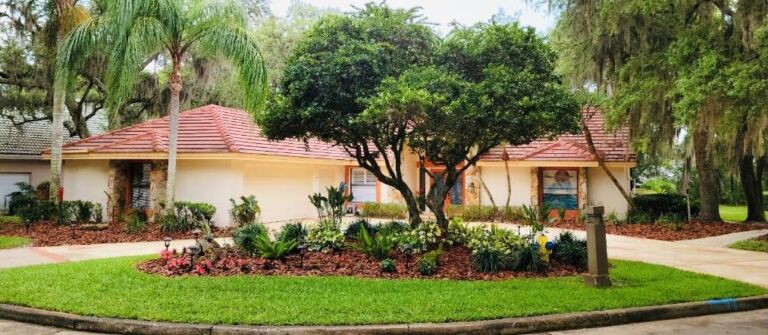
Evaluating Local Landscapers and Residential Maintenance Firms
Nutrients such as sulfur, calcium, magnesium, and others are also used by turf but are plentiful in many soils in Wisconsin so they are seldom included to fertilizer. Most yards require an average of 3 pounds of nitrogen per 1,000 ft2 annually. This is equivalent to three applications using the "normal" rates noted on the majority of fertilizer bags, approximately 1 pound of nitrogen per 1,000 ft2.
Do not go beyond 1 pound of nitrogen per 1,000 ft2 at any single applicationas the grass will not be able to use all of the nitrogen. Excess nitrogen can trigger excessive yard development, decrease the root development, motivate some illness, or perhaps kill the lawn if excessive is applied.
For high-quality turf, an easy way to remember when to fertilize is to utilize the "holiday schedule," fertilizing around Memorial Day, the 4th of July, Labor Day, and Columbus Day/Indigenous Peoples Day (early October). Suggested fertilization durations for Wisconsin yards If a low- or medium-maintenance (and quality) yard is desired, couple of fertilizations are required.
Finding Top-Rated Garden Services Near Your Residential Area
At this time the lawn is actively growing and can fully make use of the applied nutrients. Refer to Yard Fertilization for additional information. There are 2 kinds of spreaders, the drop spreader and the broadcast, or rotary, spreader. Each has advantages and disadvantages. As the name indicates, fertilizer falls through holes in the bin of a drop spreader.

Latest Posts
Top Home Garden Service Checklists for 2026
2026 Residential Landscaping Innovations for Modern Neighborhoods
The Complete Expert Lawn Service Directory Near You